Site Overlay

Custom Web Application Development for Enterprise Growth

Custom Web Application Development for Enterprise Growth
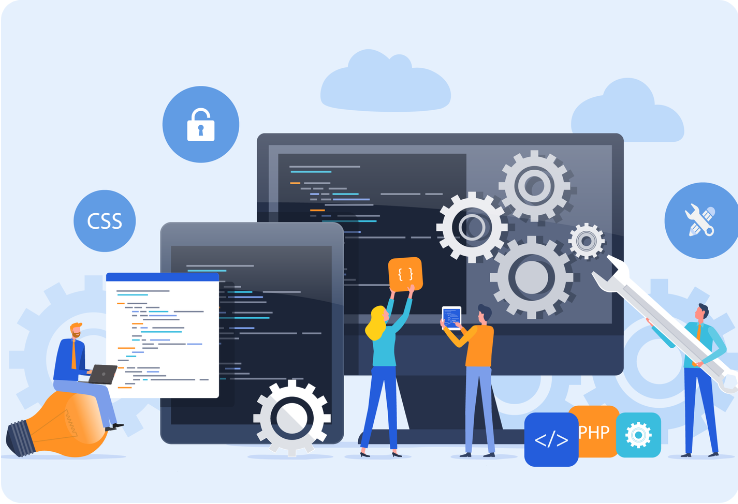
Web Application Development: How to Streamline Enterprise Operations and Accelerate Growth

The downfall of enterprise organizations often lies in systems that cannot keep up with their large-scale operations. As the business expands, legacy platforms, siloed data, and off-the-shelf software start to show their cracks. Workflows that worked for 200 employees stumble at 2,000. Integrations that were once “good enough” turn into critical bottlenecks.

Enterprise web application development solves this by creating the connective tissue that lets your entire operation move as a cohesive system. This post outlines the case for custom web development and how ITG can design web applications tailored to the complexity, scale, and ambiguity of enterprise environments. At ITG, we design custom web applications built for the complexity, scale, and ambiguity of enterprise environments. The outcome isn’t just software, it’s operational leverage.

The Case for Custom Web Application Development

Off-the-shelf platforms are built for broad markets and optimized for average use cases, not yours. The result is predictable:

  • Workarounds become standard
  • Data lives in silos
  • Licensing costs compound
  • Teams adapt to the software, not the other way around

Building a web application around your actual workflows flips that equation. Instead of forcing your operation to fit the tool, the tool is engineered to fit your operation.

The more your business scales, the more your software needs to adapt with it. Enterprise organizations operate at a level of complexity that run-of-the-mill software vendors rarely account for. You’re supporting hundreds or even thousands of users, managing workflows that span departments and vendors, maintaining legacy systems that can’t simply be switched off, and delivering customer experiences that must perform flawlessly.

This is exactly what happened when Slack’s early system was stretched to enterprise scale: even a collaboration tool had to completely rebuild its search functionality because the original design couldn’t handle the volume and complexity of large organizations.

That complexity isn’t a flaw — it’s the result of something built to last. But it also means web application development requires a fundamentally different approach than building a marketing site or a small departmental tool.

Key Features of Custom Web Applications Development

  • Scale by design: Architecture decisions made for thousands of concurrent users, not dozens
  • Deep system integration: Connects to robust CRMs, ERPs, logistics platforms, and more
  • Role-based complexity: Supports multiple user populations with different permissions and workflows
  • Long operational lifespans: Built to evolve for years, with the flexibility to handle intricate designs and scale as business needs grow.
  • Compliance and audit readiness: Security, data governance, and auditability are built into the application from the ground up.

Custom web application development isn’t right for every organization. But for sophisticated operations, it’s often the only solution that actually works.

Where Custom Web Applications Drive the Most Impact

Enterprise web application development delivers the greatest ROI when existing tools can’t keep up with growing process complexity, data volume, or user scale. Common use cases include:

  • Operations & logistics management: Custom applications that unify dispatch, inventory, vendor management, and fulfillment into a single operational layer — eliminating the manual reconciliation that slows high-volume operations down.
  • Internal workflow automation: Replaces approval chains, reporting processes, and cross-departmental handoffs that currently live in spreadsheets, email threads, or disconnected platforms.
  • Customer and partner portals: Authenticated, role-based interfaces that give external stakeholders real-time access to order status, documentation, account data, or service requests — without exposing sensitive internal data.
  • Data aggregation and reporting platforms: Applications that pull from multiple source systems — ERP, CRM, financial platforms — and surface unified reporting, dashboards, and audit trails for decision-makers.
  • Compliance and regulated workflows: Industries operating under strict data governance requirements — healthcare, financial services, government contracting — require applications where access controls, audit logging, and data residency aren’t afterthoughts.

Three examples from ITG’s work illustrate how this plays out in practice.

When a major window treatment manufacturer needed to coordinate installations across 500+ field installers in the U.S. and Canada, off-the-shelf tooling couldn’t handle the complexity. ITG built a custom platform with a dynamic installer assignment engine that factors in dealer preferences, geography, skill sets, supported products, and service territories. 

The new system manages the full work order lifecycle from quote to closure, enforces SLA tracking against predefined rules, integrates with SAP for service order data, and enforces role-based access across both the internal operations team and the installer network. 

The same client faced an equally complex challenge on the dealer side. Their dealer management workflow had grown to span over 6,000 dealers across a fragmented stack of legacy systems. ITG built and migrated the full dealer base into a unified platform that handles lead-to-order management, quote and order processing, installation coordination, customer relationship management, scheduling, and analytics — all integrated with backend systems for product configuration, pricing, and fulfillment. The migration preserved parent/child dealer hierarchies and ensured continuity for active workflows without disruption.

Neither of these problems had an off-the-shelf answer. Both required applications that were designed around the operational reality — not the other way around.

A third example illustrates what happens when the integration problem goes unsolved for too long. GNC had spent over three years trying to successfully deliver a fully transactional mobile application. But in the end, both efforts were cancelled. The root cause wasn’t a technology problem, but one of consensus. How do we get consistent buy-in from several stakeholders on a single, shared vision?

ITG installed experienced digital commerce architects to take direct ownership of that gap, implemented enterprise-grade QA and release infrastructure across both app stores, and delivered a fully functional native application on iOS and Android within three months. Three years of delays, three months to ship, which clearly demonstrated ownership, instilled confidence, and secured buy-in across stakeholders.

If your teams have built workarounds on top of workarounds, or if a critical workflow depends on manual steps that don’t exist in any system of record, that’s a signal that custom development belongs in the conversation.

What Operational Improvement Actually Looks Like After Custom-Made Web Application Development

The business case for custom web application development is straightforward when you examine the inefficiencies that cost at scale. Recent industry research shows that complexity and fragmentation in enterprise software is costing businesses billions each year. Teams juggle dozens of tools that don’t communicate with one another and rely on manual workarounds, spending hours on tasks that should be automated.

The outcomes ITG clients typically realize fall into three categories:

Blog- Icon-_efficiency gains

Efficiency gains

Reduction in manual processing time, fewer error-correction cycles, and faster cycle times across core workflows. These are measurable from day one of deployment.

Blog- Icon-_headcount growth

Scalability sans headcount growth

Well-architected applications allow transaction volume, user load, and operational scope to grow without requiring equivalent increases in staffing or infrastructure spend.
Blog- Icon-_decision speed

Data integrity and decision speed

When data flows through a single, integrated application rather than across disconnected tools, reporting becomes accurate and real-time. Leadership spends less time reconciling numbers and more time acting on them.
Ready for Customized Web Solutions That Fit Your Operation?

Most enterprise organizations reach a point where the cost of maintaining the status quo exceeds the investment required to fix it. Custom web application development is how organizations at scale stop adapting to their tools and start building infrastructure that adapts to them.

If your current systems are limiting what your operation can do, ITG can help you define what the right solution looks like and build it to last. Contact us today to discuss your current challenges and how we can help. 

You’re in good company

For business development, call us at (513) 769-1900 or Contact Us

You’re in good company